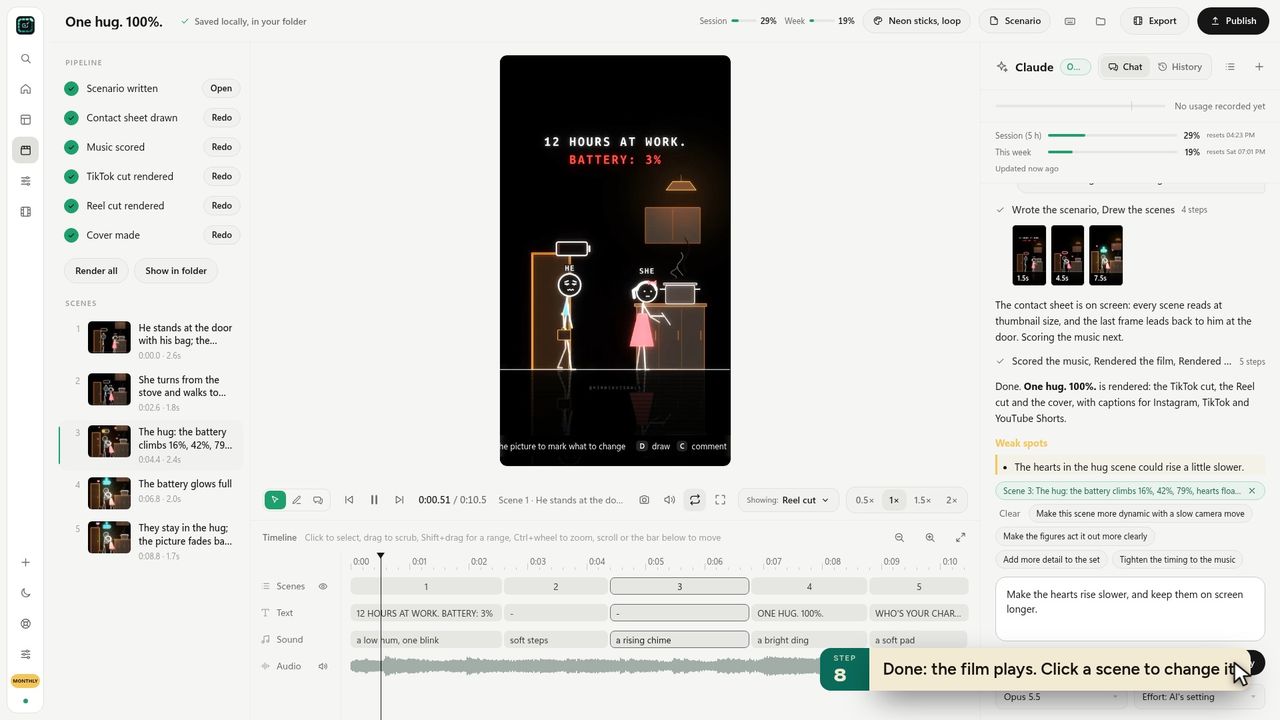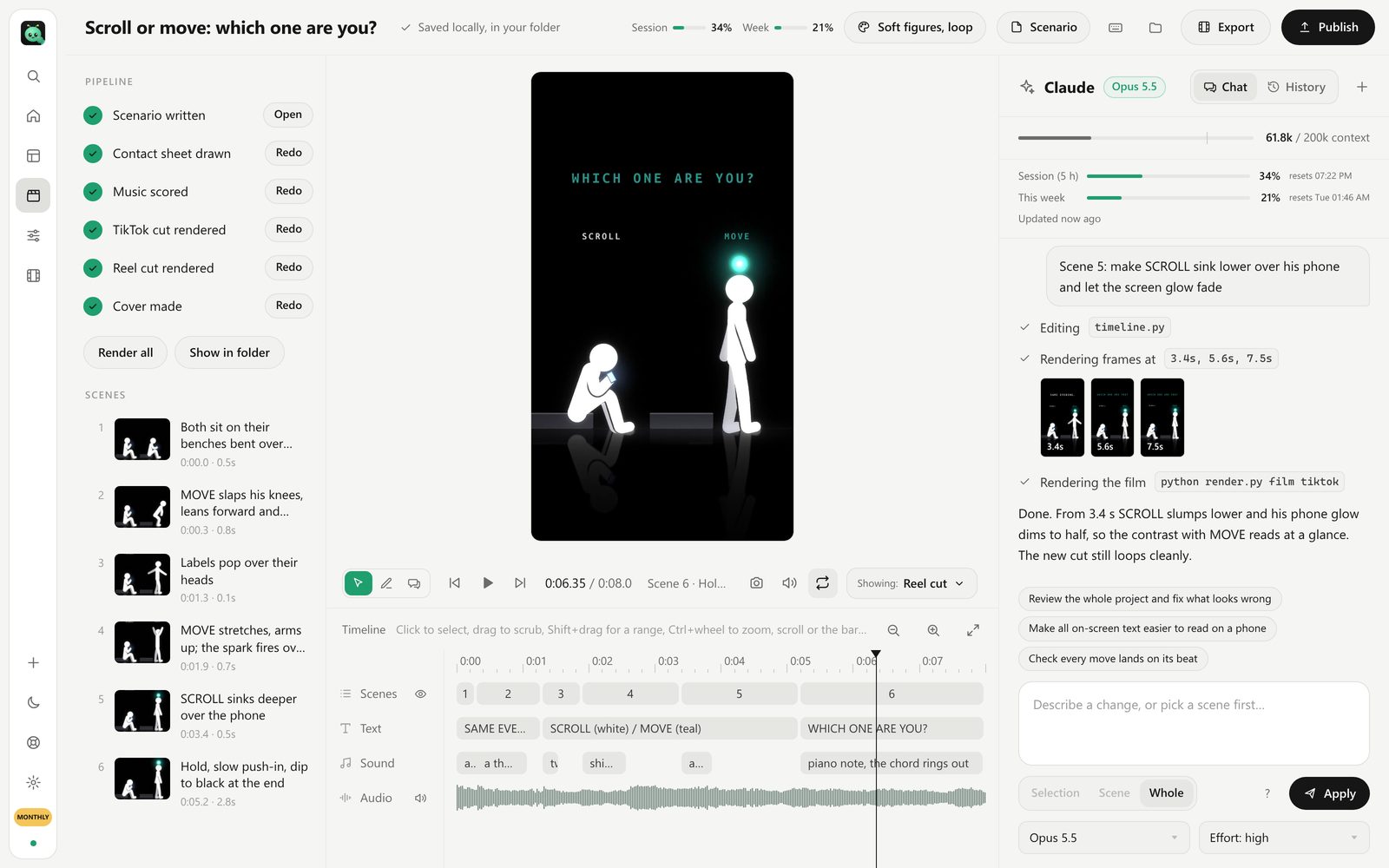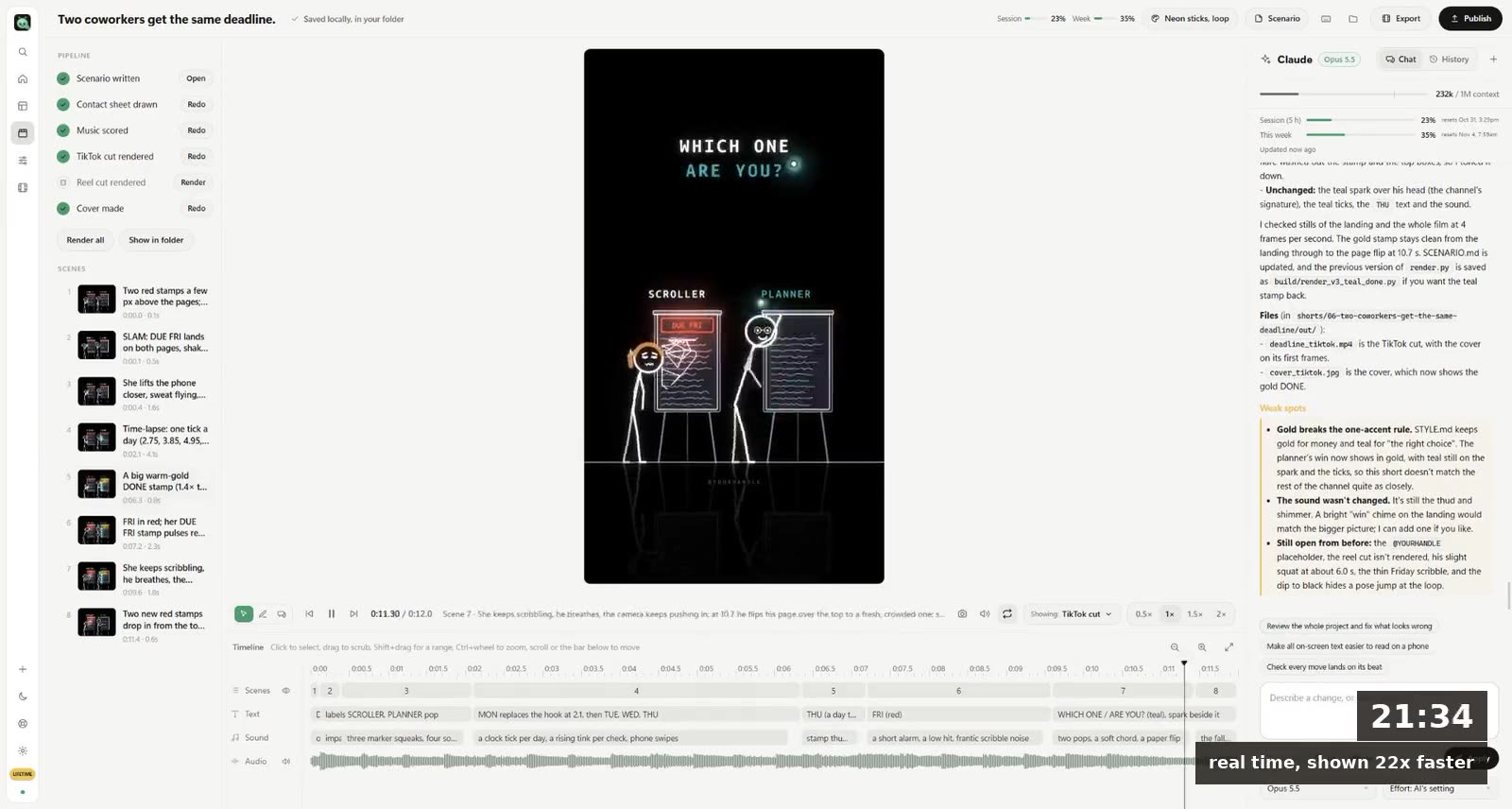
To make animated story videos with AI: write the story as a few beats with one turn, give each character a fixed look and voice, let the AI draw and animate every scene in one style, add narration or character voices, and end on a line that makes people comment. A 60-second story takes one paragraph and under an hour.
Story channels are some of the most watched faceless channels on YouTube and TikTok: what-if stories, "a day in the life of", moral tales, history with a twist. The format is old. What's new is that one person can now make one a day.
What makes a story video work
A good short story video has three things a random clip doesn't:
- A question in the first second. "What if you woke up as your dog?" The viewer stays to find out.
- Characters with faces. Big heads, clear expressions. People watch faces, even cartoon ones.
- A turn at the end. The twist, the lesson, the line that makes someone tag a friend.
Step 1: Write the story in beats
Not a script yet. Five to eight beats, one line each:
- Mia wakes up and she's the dog.
- Her mum talks to her in a baby voice.
- She tries to tell her and only barks.
- She finds out what the dog does all day: waits by the door.
- The dog, in Mia's body, comes home from school and hugs her.
- Mia, the next morning, back as herself, sits by the door with the dog.
The turn is beat 4. Everything before builds to it, and beat 6 is the feeling people share.
What goes wrong: too many events. A 60-second story holds one idea. Stories that try to fit a whole plot read like a trailer.
Step 2: Fix the characters
Describe each character once and keep the description: shape, two colours, one thing that's only theirs. If Mia has a yellow raincoat in scene one, she has it in scene six.
This is where AI tools differ. Video models make a different face in every clip. Code-drawn animation draws the same character every time, because it's the same drawing. Why that matters.
Step 3: Pick a story style
The style should fit the stories. In FramePillar:
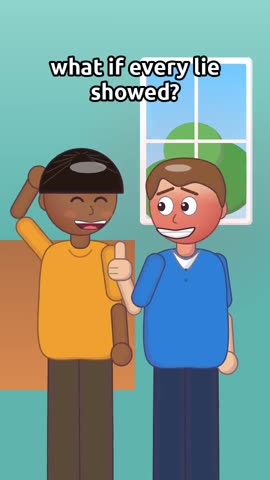
- What-if cartoon: big-headed people with very expressive faces that blush, sweat and talk, in bright rooms. Made for narrated what-if stories.
- 3D cartoon: round characters in little worlds with soft film light.
- Hand-drawn: ink lines drawing on as the pen moves, for gentle, warm stories.
- Paper cut-out and Silhouette for fables and history.
Pick one per channel.
Step 4: Make it
- New video → Start from scratch. Paste the beats and the character descriptions.
- Look: the style, Vertical 9:16 for Shorts and TikTok or Wide 16:9 for a YouTube video, 45 to 90 seconds for a short story.
- Create video. Claude writes the scenario from your beats, draws a contact sheet, animates every scene and scores music.
Check the contact sheet before the film: right characters, right order, the turn where you want it.
Step 5: Add voices
Story videos are better with sound on. Two ways:
- A narrator. Connect ElevenLabs in Settings and pick a voice. The narration is written with the scenario and timed to the scenes.
- Character voices. When several characters talk, each gets their own voice.
- Your own voice. Record it under the player while the film plays slowed down to 0.85×, 0.7× or 0.5×.
Keep words on screen too. Many people still watch muted.
Step 6: End on a question
The last line should make people comment: "Would you want to know what your dog does all day?" Then pin your own comment with the same question. Comments under story videos are full of the viewers' own stories, and those are your next ideas.
Stories for kids
If your stories are made for children, YouTube requires you to mark them Made for kids. Those videos get no personalised ads and no comments, so they earn less per view. Decide before you start which audience you're making for.
Questions
Can AI make a whole animated story?
Yes. From a paragraph of beats, a code-drawn tool makes the scenes, the animation, the music and the voices. You check and change scenes rather than drawing them.
How long should an animated story video be?
45 to 90 seconds for TikTok and Shorts; over a minute if you want TikTok's Creator Rewards to pay. A few minutes for YouTube.
Can story channels make money?
Yes: platform payouts, brand deals and sponsors who fit the stories. See how to make money with AI animated shorts.
Not a promise of earnings. Results vary and depend on your work.