Text to animation AI turns a written idea into an animated video. There are two kinds of tool. Video models paint pixels from your prompt: fast, but the character's face changes between clips and you can't fix one detail. Code-drawn animation has an AI write the scenes as code, so characters stay the same and any scene can be changed in a sentence. For shorts you'll post every day, the second kind holds up better.
The difference shows the moment a story has more than one shot. If the hero in clip three isn't quite the hero from clip one, viewers notice. Our shorts that got 16.4 million views in a week were all drawn in code, the rope one included.
The two kinds of text to animation
Video models: describe it, get a clip
Most "AI animation generator" pages you'll find work like this. You type a prompt, a model generates a few seconds of moving picture, and you string clips together. The pictures can be beautiful.
The trouble starts at clip two. Each generation is its own roll of the dice, so the same character drifts: a different jacket, a slightly different nose, an arm that wasn't there. And when one clip is 90% right, you can't ask for "the same, but his hand reaches the phone a second later". You regenerate and hope.
Good for: one striking shot, a background, a mood.
Code-drawn animation: describe it, get a scene you can edit
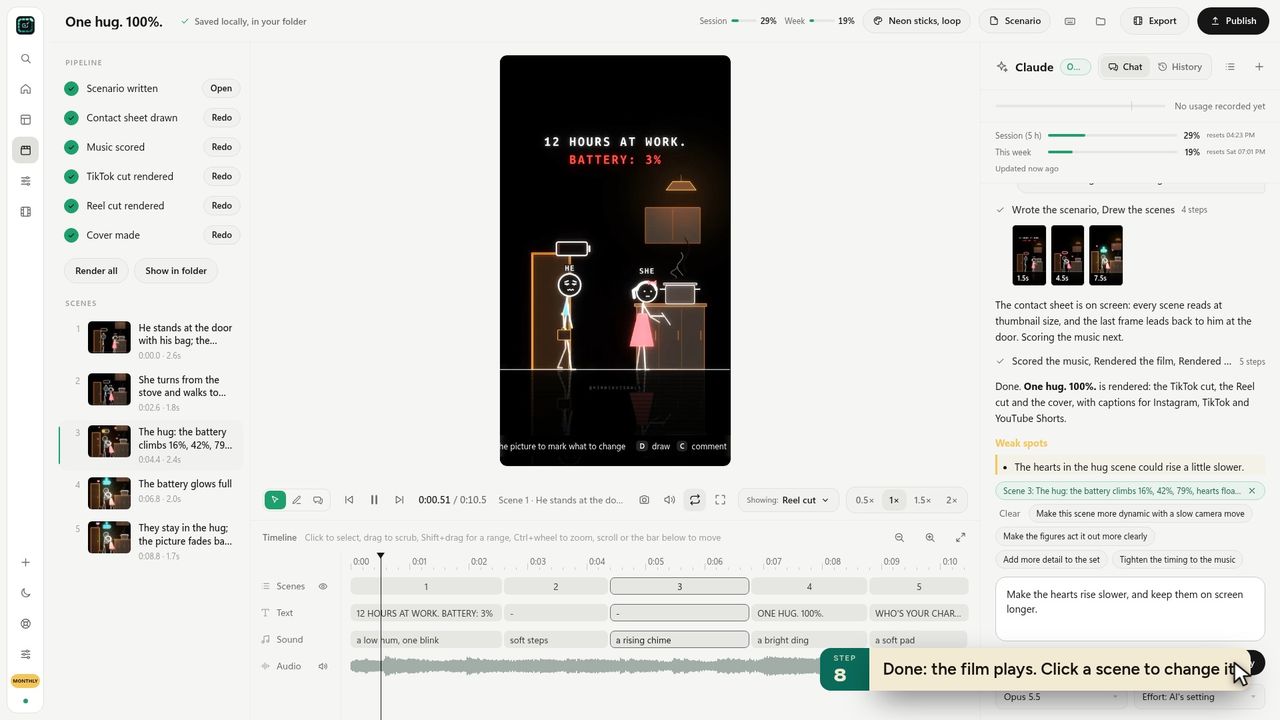
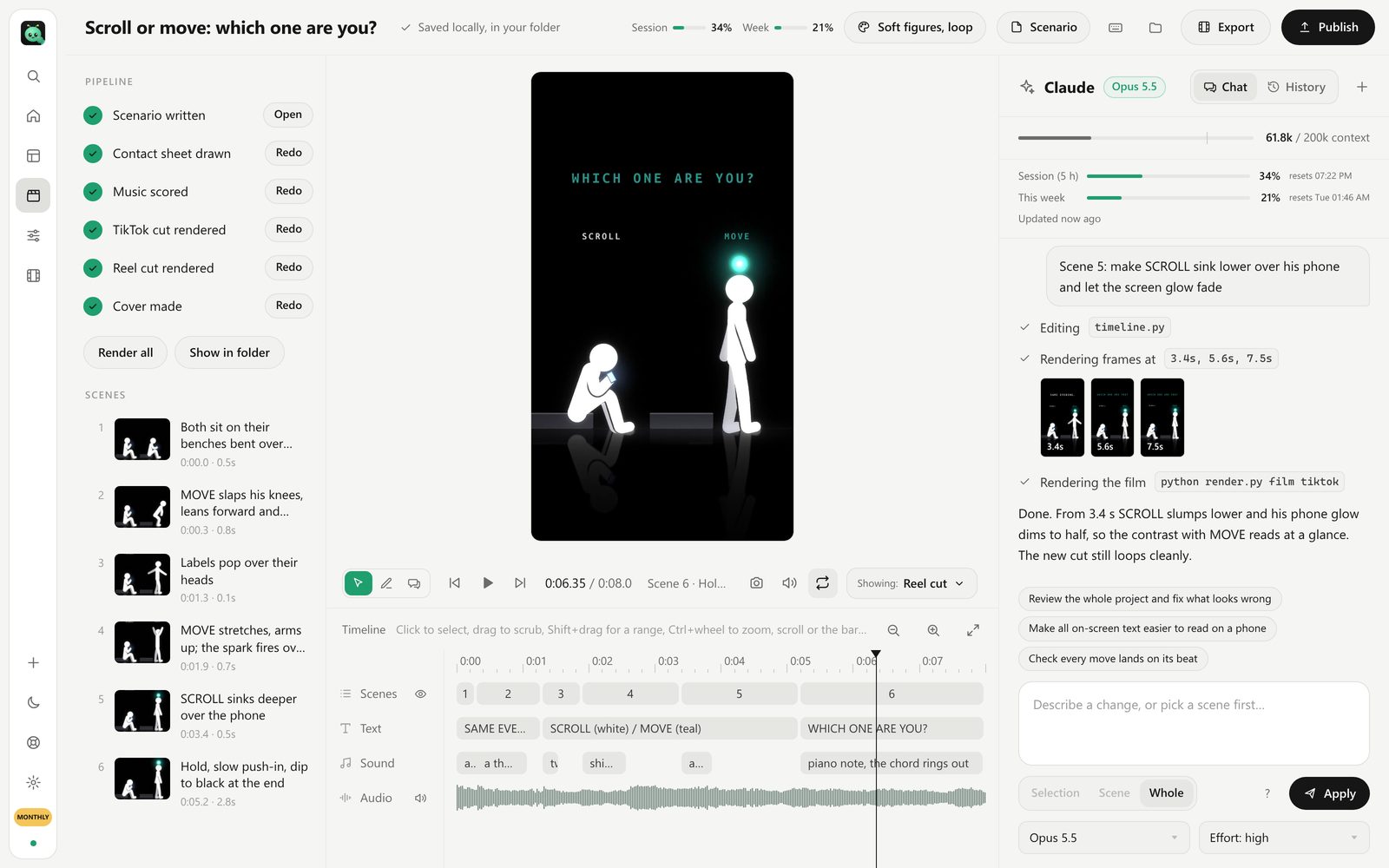
Here the AI (Claude Code or Codex) writes code that draws each frame. The character is a set of rules (these lines, this colour, this way of walking), so he looks the same in scene one and scene forty. And because everything is a rule, changes are precise: "make the title land four frames earlier" is a one-line edit, not a re-roll.
The trade-off: it doesn't do photoreal. Think stick figures, flat cartoon, ink and paper, pixel art, glowing neon lines. Which, conveniently, is what does well on TikTok and Shorts.
Good for: shorts with a recurring character, series, explainers, anything you'll edit.
| Video model | Code-drawn | |
|---|---|---|
| Same character across scenes | Drifts | Stays the same |
| Change one detail | Regenerate the clip | Ask in a sentence |
| Photoreal | Yes | No |
| Typical styles | Cinematic, 3D, anime | Stick figure, flat, ink, neon, pixel |
| Length | Short clips you join | Any length, scene by scene |
How to turn one sentence into an animated short
This is the code-drawn way, which is what we do every day.
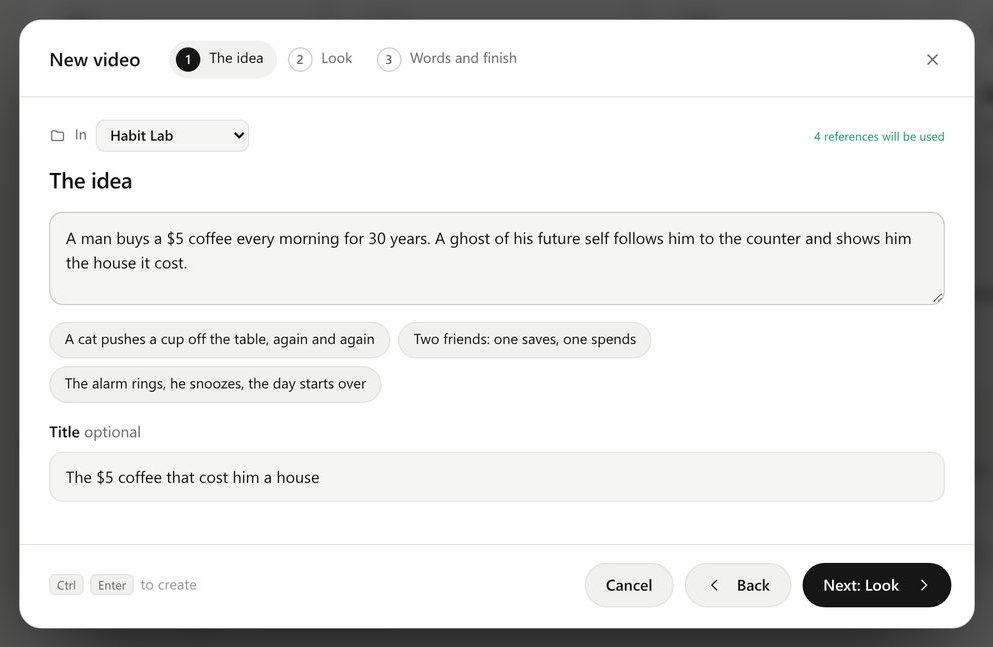
1 Write the sentence as a story, not a topic
"A video about procrastination" gives the AI nothing to draw. "He swore he'd start at 9. At 9 he made coffee. At 11 he reorganised his desk. At 4 he started, and finished by 5." gives it four scenes and an ending.
A good sentence has a person, a want and a turn. The turn is what people share.
2 Pick the look before the scenes
A style decides line weight, colours, how characters move and what the background is. Choosing it after the scenes are written means redrawing all of them. Glowing stick figures on black are the safest bet for a first short; our 9.3-million-view short is exactly that, and we wrote up how that style is made.
3 Get the first second right
On TikTok and Reels the first second decides whether anyone sees the rest. Open on the most surprising frame of the story, not the setup. If you're stuck, these 40 hooks are sorted by type.
4 Check stills, then render
Ask for one frame from each scene, side by side, before the full render. It takes seconds and catches the caption under the platform's buttons, the scene with nothing happening and the joke that lands too early.
5 Change scenes, not the whole video
Watch once, note what's off, fix one scene at a time. "Scene 3: hold on his face for a full second before the cut." Small notes get exact fixes.
6 Export for each platform
1080×1920 for TikTok, Reels and Shorts, with text out of the bottom fifth. 1920×1080 for a long YouTube video. Same story, different cuts.
What to make with it
- Relatable little stories. Work, family, phones, sleep. The faceless channel ideas list has twenty niches with a first line for each.
- Explainers. How a loan works, why the sky is blue, what a recession is. Charts and arrows are where code-drawn animation shines.
- A series with one character. The thing video models struggle with most is the thing that builds a following: the same face every day.
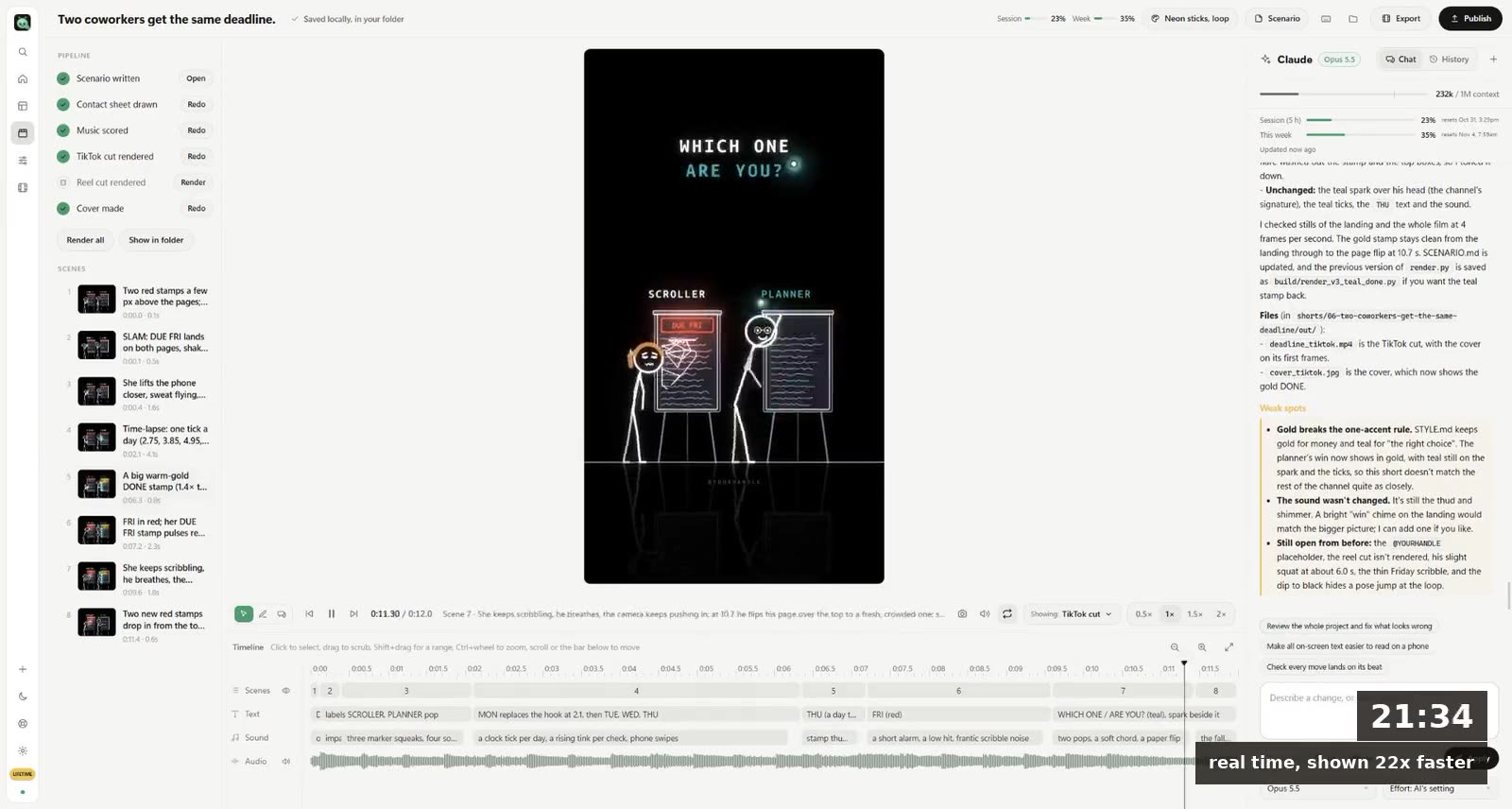
- Long YouTube videos. Ten minutes drawn scene by scene is a few evenings, not a few weeks.
Doing it in one app
FramePillar is a desktop app for Windows and Mac that does the code-drawn kind. You type the sentence, pick a style from the library, and it uses Claude Code or Codex on your own plan to write the scenario, draw every scene, add music and make the TikTok, Reel and YouTube versions. Click any scene to change it by asking.
The first-short lesson shows one video from sentence to file, and the styles lesson shows how to switch the look. It's $19.90 a month, with 3 days free.
If you'd rather set it up yourself, we wrote down the whole pipeline for Claude Code and for Codex.
Questions
What is the best text to animation AI?
It depends on what you post. For one cinematic shot, a video model. For shorts with a recurring character that you'll edit and post often, a code-drawn tool, because the character stays the same and every scene can be changed.
Can AI create realistic motion from a simple sentence?
Yes, video models like Sora, Veo, Kling and Runway turn one sentence into a realistic clip of a few seconds. They still slip on hands, physics and the same face across shots. Where they hold up and where they break is in can AI make realistic motion from one sentence.
Can AI make a whole animated video from text?
Yes. A code-drawn tool can go from one sentence to a finished short with scenes, music and captions. Video models make short clips that you join yourself.
Is text to animation free?
Many generators have a free tier with a watermark or a few seconds of video a day. Code-drawn animation runs on a Claude or ChatGPT plan you may already pay for.
Can I monetize AI animated videos?
Yes, as long as each video is a real, different piece of work. YouTube's rules target mass-produced, repetitive uploads, not AI as such. We went through what the monetization rules say.